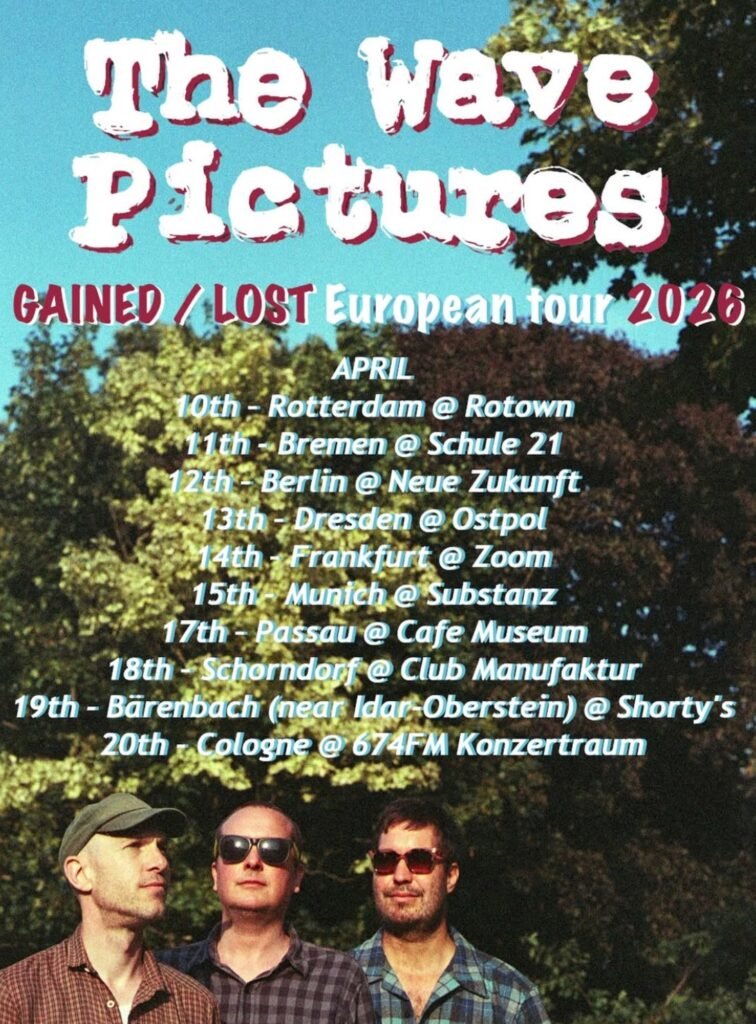
THE BRITISH BAND WILL BE TOURING CENTRAL EUROPE ON APRIL, AND ON MAY 9TH THEY WILL PERFORM IN LONDON
The Wave Pictures return with Gained/Lost, an album that showcases the three key elements of their sound: classic songwriting, musical virtuosity, and dreamlike lyrics. With this record, they capture the joy of playing together — a special chemistry that has established them as one of the most enduring cult bands in Great Britain.
Below are the responses from David Tattersall (guitar and lead vocals), some of which are very much in tune with the views of the person conducting this interview.
-I hate technology! I think they should have halted all progress back in the 90s-
After so many years releasing music, what makes Gained/Lost special within your discography?
I don’t know, it’s not my place to say whether it’s special or not, really. Maybe it isn’t special! I put my heart and soul into it, that’s the truth, I put everything I had into it, but it’s not for me to comment on whether it is or isn’t special. My attitude is that I put everything I possibly have into the albums. I work on them day and night. I’m thinking of nothing else. But once they are finished I never look at or listen to them ever again.
The album blends 60s garage rock, 70s classic rock and 90s American indie. Was that combination intentional?
I’d go back way earlier even than the 60s, I’d go back to the 20s and before. We always felt that this music goes back a very long time, way earlier than the recording era. All the songs from all the roots music of the world, all have the same chords, the same harmonic relationships. If you listen to Blind Lemon Jefferson or Mississippi John Hurt recordings from the 1920s, those songs are basically the same as all the songs ever since. So there is a huge universe of song. Every song is attached to every other song. It’s all the same music. People think there are many different kinds of music, but they are confusing music with marketing. They’ve got muddled. A soul song and a reggae song and a blues song and a rock song and a country song… etc etc. These are all the same. They are all made of the same stardust. It’s only someone in marketing who comes along and later and says this goes over here, and this goes over there.
The DIY spirit is still very present in your music. Is that an aesthetic choice or an artistic necessity?
It’s counter-cultural dude. We want to have fun and smash the machine!
Your lyrics often feel very visual and dreamlike. Where does that come from?
Lyrics are where it all starts for me. I was always interested in the idea of lyric writing as a form of writing like any other. I always had a special problem with music growing up, because I was very disturbed and upset by the lyrics. It’s true, I really struggled with them. Other people always took them for granted but I always heard them like someone talking to me, but saying strange things. All the music I heard, I thought it was very strange.
Then one day I heard Bob Dylan singing «Visions of Johanna», «Stuck Inside of Mobile, Leopard Skin Pill Box Hat», and all these really interesting things, and I experienced this enormous sense of relief.
My Dad had the Blonde on Blonde album, and when he played it to me I experienced this enormous sense of relief. That someone was doing something with lyrics. Instead of all the gibberish, here was someone actually being fun.
What are most people doing? They just put random word sounds over melodies, let’s be honest, that’s why it is so confusing for people like me who concentrate on the lyrics. The awkwardness of that always upsets my ear. But Bob Dylan really says interesting and funny things. He isn’t the only one, of course, there are loads of great lyric writers over the years. But Bob Dylan was the first I heard where the lyrics actually mean anything at all. Then later I heard Lou Reed, and I almost fell out of my chair because it was so good.
So I always write the lyrics first. I basically have zero interest in melodies. I just write lyrics and put everything into my lyrics. In my deluded mind, I’m a beat writer, like Jack Kerouac or William Burroughs, writing my lyrics. This is a delusion, of course, but I really believe in the lyrics when I’m writing them. Later on I can look back and say that they are very stupid, but this doesn’t matter at the time!
I set the lyrics to simple chords, very simple. I like simple chord sequences, because I believe in the power of simple chord sequences. If you look at music history, as I was saying before, simple chord sequences are the key factor in all roots music of the entire world. Then when you get into complicated chord sequences, you’re talking about classical music, jazz music, or sophisticated urban pop music… Those things are fine, but they don’t grow out of the earth like potatoes. They aren’t of the universe in the same way. Those types of music come from educated intellectual minds. But all the roots music of the world have very simple chords. So that’s the secret of The Wave Pictures massive success. Really complicated lyrics and really simple chords: that’s the dream team.
The first track is «Alice», What role does this song play in the overall album?
It gets you right in there, right into a dream. It’s a great opening line. There’s a camera in the sky and it comes down into the scene. That’s in your mind’s eye. But the whole universe could be inside your mind.
You recorded the album in just seven days. What does working that way bring to the music?
Spontaneity, life. It breathes. The death of music is caused by people recording for too long. They killed themselves, they made themselves disappear, they turned themselves into ghosts in the machine. That’s what they did. If you look at all the great music, like Blind Lemon Jefferson, Muddy Waters, straight through early Elvis, The Velvet Underground, The Ramones, on to Guided By Voices… it was all recorded very quickly. That’s all the good shit that matters.
Then you look at the bad shit, all the horrible pop shit. I won’t start naming names here. But everybody knows. All the horrible pop. All the stadium rock. All the prog rock. All these people who can’t play. Who aren’t fun. They can’t write lyrics. They aren’t connected to the universe. Their music doesn’t come out of the earth. Millionaires with no souls. Everybody knows. People like it that way, they like all that shit. But that’s what makes the world go wrong, different opinions. I don’t think I’m right and such-and-such is wrong. It’s simply that to me, music is a cosmic thing. It’s not an ego trip. And it’s not a plastic pop confection.
The artwork feels very personal. What did you want to express with it?
It’s very personal. I put all the things I love into it. I wanted it to look like the cover of Exile On Main Street, except personal. Personal things from life.
You’re coming back to Spain in March. How is your relationship with the Spanish audience?
I feel a deep gratitude for Spain. Before we came there, nobody liked our music. I love Spain. I love the food, the culture, all the happiness and laughter, how playful and funny and crazy everybody is. I love Spain and I’m deeply grateful to Spain.
After more than two decades, what still keeps the band motivated?
Drugs and money.
How would you like people to experience Gained/Lost for the first time?
Every album, it’s always my hope that people will listen to them al the way from start to finish, in order. Not looking at their phones or talking or whatever. You always hope for that perfect listener, who maybe smokes a spliff, or pours a glass of red wine, lights a candle, and sits down to listen to the album really attentively. I listen to music like that. I like to immerse myself in it. I’m not that into background music, I find it kind of distracting. What happens to me when I listen to music is I see all kinds of visions in my mind. It’s very powerful. So I tend to prefer listening to music when I’m alone. But when there’s music playing and I’m out and about, like in the pub, I have to work quite hard to block it out, because it’s got so much information in it. I find it kinda tiring.
So I’m a bit crazy that way. It’s a blessing and a curse I suppose, because I hear so much in music. And I LOVE the music that I like. And I HATE the music that I don’t like. I couldn’t be more extreme. It’s like torture to me, a lot of the time, the music that I hear when I’m out and about. So similarly, I suppose with the music The Wave Pictures make, I imagine it has the potential to save someone’s life, because it’s very very specific and strong music, but it also has the potential to be hated, and believe you me, it’s been hated by a lot of people! It’s obvious that my intense relationship to music as a listener, or as a weird person who finds background music hard to cope with, has been a big factor in The Wave Pictures’ music!
What’s your opinion on AI — in music and as a technological tool in general? Do you see yourselves as friends of AI?
I hate technology! I think they should have halted all progress back in the 90s when a computer first beat a human at chess. Deep Blue was the computer. And Kasporov was the chess player. And even then I thought »this is getting out of hand», we don’t want computers to be more intelligent than we are. If it was up to me I would taken an axe right then and smashed it all up. Haven’t these people seen 2001 or The Terminator? The writing’s on the wall.
But the truth about music is that people had turned themselves into robots anyway. All the music sounds robotic. Might as well have a robot actually making it. That’s the final step. To be honest, I’m probably a crazy person. It’s very very important that I’m not in charge of anything at all in the world! Because if I was in charge, everything would go to hell immediately! So I could be very wrong, I accept that. But if you were to ask me what I was most worried about, much more than politics or the environment or anything, by far the thing that I am the most worried about in the world is technology. By far.
Can you give us an overview of your musical journey, from your teenage years up until now?
I started out playing folk guitar, acoustic guitar instrumentals. I suppose you could say I was a child prodigy! I would play in folk clubs and things when I was ten, eleven, twelve years old. I would play Rev Gary Davis tunes and John Fahey tunes and things like that. When I got older, I got to be about 14, I stopped wanting to do it. I hated it. I hated guitar teachers always telling me what to do. I hated guitar people. I hated practising. And I hated folk clubs. So I started a rock n roll band with some friends who couldn’t play at all, not at all. They had never even seen a musical instrument. I had to teach them. But for me, this was a new thing to do where no one could tell me I was doing it wrong because I decided that it was up to me from then on what I did and no one could say what was right or wrong. I wanted to write songs and sing them and play with my friends. And that’s what I’ve carried on doing. I was very interested in writing.
I was very interested in William Burroughs andJack Kerouac and Allen Ginsberg! I loved in the idea of lyric writing being a form of writing. And I was very keen to express myself. And I wanted to take my friends with me. And play music.